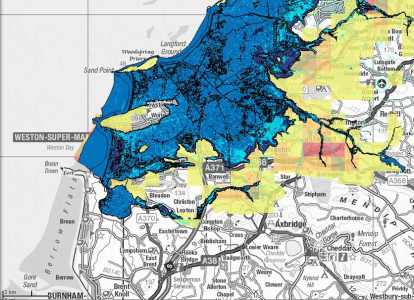
If you’re planning a new dwelling, replacement dwelling or change of use in North Somerset, you may be asked to provide a Sequential Test or Exception Test as part of your planning application.
These tests are required when development is proposed in areas of flood risk — and given the extent of modelled and existing flood zones across North Somerset, they are requested frequently.
At Gibson Architecture, we are recognised as one of the most successful local practices for preparing Sequential and Exception Tests.
We are regularly instructed not only by homeowners, but also by fellow architects and planning consultants who rely on our clarity, structure and high success rate.
Why These Tests Are Needed in North Somerset
North Somerset Council’s Planning Map shows extensive areas affected by:
- Tidal flood risk
- Modelled future tidal flood risk
- Fluvial (river) flood risk
- Surface water flooding
- Climate change allowances
Because of this, the council often requires Sequential and/or Exception Tests for:
- New dwellings
- Replacement dwellings
- Barn conversions
- Changes of use
- Intensification of use
- Some larger extensions
- Prior Approvals in flood zones
Even small rural sites can trigger the requirement due to modelled future flood levels.
What Is the Sequential Test?The Sequential Test ensures that development is located in the lowest flood‑risk area reasonably available.
In simple terms, the council asks:
“Is there another site at lower flood risk where this development could reasonably go?”
If the answer is no, the Sequential Test can be passed.
When the Sequential Test is required:
- New dwellings in Flood Zones 2 or 3
- Replacement dwellings in Flood Zone 3
- Barn conversions to residential use
- Changes of use to a more vulnerable category
- Some commercial developments in flood zones
When the Sequential Test is NOT required:
- Householder extensions
- Minor alterations
- Outbuildings
- Some agricultural structures
We always confirm this early, so clients know exactly what is needed.
How the Sequential Test Works
A robust Sequential Test typically includes:
1. Defining the search area
Usually the parish, settlement boundary or housing market area.
2. Identifying alternative sites
Using the Local Plan, HELAA, planning history and available land.
3. Assessing flood risk of alternatives
Comparing each site’s flood zone classification.
4. Demonstrating lack of suitable alternatives
If no lower‑risk sites are available, the test is passed.
Our assessments are clear, well‑structured and aligned with North Somerset’s expectations.
What Is the Exception Test?
The Exception Test is required when:
- The development is in Flood Zone 3, and
- The vulnerability classification or policy position requires it
The Exception Test has two parts:
Part A — Wider Sustainability Benefits
You must show the development provides wider community or planning benefits, such as:
- delivering housing
- reusing existing buildings
- improving energy efficiency
- enhancing the local environment
- supporting rural communities
Part B — Safe for Its Lifetime
You must demonstrate the development will be safe from flooding for its lifetime through:
- raised floor levels
- flood‑resilient construction
- safe access/egress
- appropriate drainage
- mitigation measures
We prepare both parts clearly and comprehensively.
When the Exception Test Is Required
You may need the Exception Test if:
- You are proposing a new dwelling in Flood Zone 3
- You are replacing a dwelling in Flood Zone 3
- You are converting a building to residential use in Zone 3
- The council specifically requests it
- The vulnerability classification increases (e.g., commercial → residential)
We confirm this early in the design process.
How Gibson Architecture Prepares Sequential & Exception Tests
We are widely recognised as one of the most successful practices in North Somerset for preparing these assessments.
Our work is:
- Clear
- Robust
- Policy‑aligned
- Well‑structured
- Highly defensible
Because of this, we are regularly instructed by:
- Other architects
- Planning consultants
- Developers
- Homeowners
Our reports typically include:
- Flood zone mapping
- Modelled flood levels
- Climate change allowances
- Site‑specific risk analysis
- Sustainability benefits
- Mitigation strategies
- Safe access/egress analysis
- Drainage considerations
- Full compliance with NPPF and local policy
We can provide these:
- Independently, if you only need the tests
- As part of a full planning package, including drawings, FRA and submission
How Much Do Sequential & Exception Tests Cost?
Updated 2026 pricing:
Sequential Test:
£350 – £550
Exception Test:
£250 – £450
Combined with an FRA:
Discounted when included within a full planning package.
Costs depend on:
- Flood zone
- Complexity
- Whether both tests are required
- Whether additional modelling or drainage analysis is needed
How Long Do They Take?
Most assessments can be completed within:
5–7 working days
More complex cases (e.g., multiple dwellings or Zone 3b) may take slightly longer.
Thinking About a Project in a Flood Zone?
If your site falls within Flood Zone 2 or 3, and many in North Somerset do, we can help you understand what is required and prepare a clear, compliant Sequential and/or Exception Test.
Get in touch:
01934 805987
gibsonarchitecture.co.uk
Weston‑super‑Mare, North Somerset